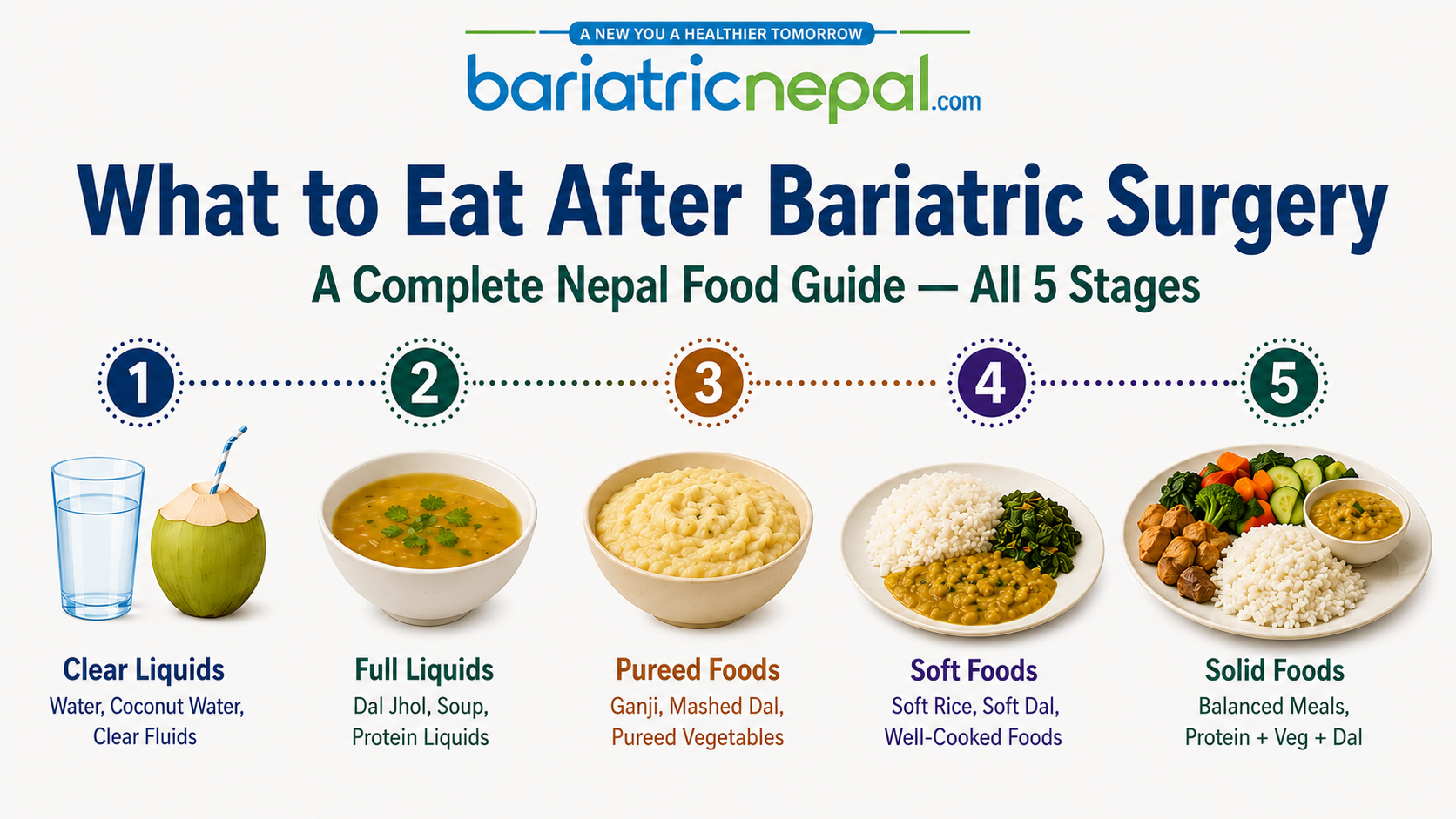
A complete, stage-by-stage food guide with 20+ items per stage — written for patients in Nepal using everyday Nepali foods
Bariatric surgery — whether it is a sleeve gastrectomy, gastric bypass, or another type — changes the size and shape of your stomach permanently. After surgery, your stomach can hold only a very small amount of food at one time. Because of this, the way you eat must also change — slowly and carefully, step by step.
In Nepal, this process can feel confusing and even lonely. Our food culture is built around large, shared meals — dal bhat twice a day, heavy festive foods during Dashain and Tihar, and the deeply rooted belief that eating less means you are unwell. After bariatric surgery, all of this needs to change. Not forever in a sad way, but in a healthy, mindful way that protects your new, smaller stomach while still letting you enjoy Nepali flavours.
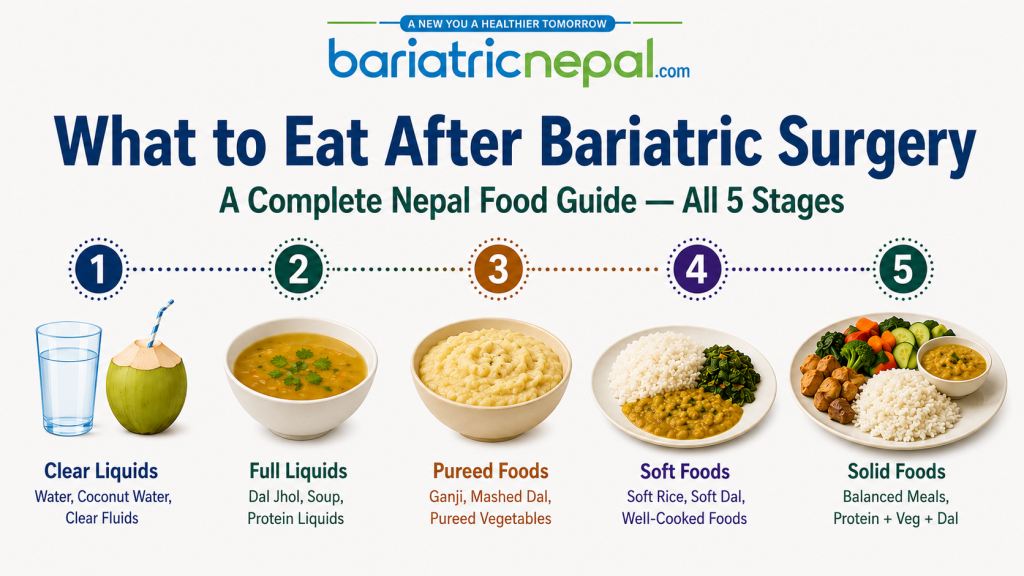
Food after bariatric surgery follows a clear progression called food stages. You start with thin liquids and move slowly toward regular food over several weeks and months. Each stage is important. Skipping a stage or eating the wrong food too soon can cause serious problems — nausea, vomiting, dumping syndrome, blocked food, or even damage to your healing stomach.
This guide explains all five stages clearly, using everyday Nepali foods that are easy to find in your kitchen. Share this with your family — especially the person who cooks for you. Their understanding and support is one of the most important parts of your recovery.
5 golden rules to follow at every stage
1
Eat small amounts — never fill your stomach more than three quarters full
2
Chew very well — every bite must be chewed until almost liquid before swallowing
3
No drinks with food — wait 30 minutes before and after every meal to drink
4
Protein first — always eat your protein before rice, roti, or vegetables
5
Take your supplements — vitamins and minerals every single day, for the rest of your life
Quick overview — the 5 food stages
1
Days 1–3: Clear liquids only — water, coconut water, strained clear broth, ORS
2
Days 4–14: Full liquids — strained dal jhol, thin lassi, smooth dahi, protein shakes
3
Weeks 3–4: Pureed foods — mashed potato, dhido, ganji, mashed fish and chicken
4
Weeks 5–8: Soft foods — soft rice, boiled egg, steamed fish, soft vegetables
5
2 months+: Regular foods in small portions — protein first, 5–6 small meals every day
1
Days 1 – 3 after surgery
Clear liquids only
See-through only
Your stomach needs full rest. Only drink thin, clear liquids you can see through. Sip slowly — 30 to 60 ml at a time. Never gulp. Drink small amounts all through the day.
✓ What you can eat and drink
●Plain water — sip slowly all day
●Fully strained chicken bone broth
●Strained vegetable soup water (clear)
●Coconut water (nariwal pani) — no pulp
●ORS (Jeevan Jal) — helps with weakness
●Weak black tea — no milk, tiny sugar
●Warm water with a squeeze of lemon
●Thin apple juice — no pulp, diluted half
●Ice chips or ice water — melted slowly
●Tulsi tea (plain, weak, no milk)
●Ginger tea — very weak, no milk
●Strained tomato water (no pulp)
●Strained mutton yakhni (no fat, no pieces)
●Clear rice water (maad) — very thin only
●Electrolyte solution (doctor-approved)
●Hibiscus tea (chor pate ko chiya — plain)
●Mint water — fresh mint boiled and strained
●Barley water — boiled, strained clear
●Cucumber water — plain slices in water
●Glucose water — very light, if doctor allows
●Chamomile tea — weak, plain
●Warm lemon honey water — tiny honey only
✗ Avoid completely at this stage
✕Any milk or dairy drinks
✕Cold drinks or sodas
✕Juices with pulp or pieces
✕Dal, rice, roti — anything solid
✕Lassi or yoghurt drinks
✕Alcohol of any kind
✕Soup with vegetable or meat pieces
✕Very sweet drinks — too much sugar
Key rule: Only 30–60 ml at one time. No gulping. Drink slowly every 15–20 minutes all day. If you feel sick or vomit, stop and call your doctor.
You can now have thicker, smooth liquids. Nothing chunky or chewy. Everything must be drinkable without any chewing. This is when many Nepali foods slowly come back — in liquid form only.
✓ What you can eat and drink
●Thin dal ko jhol — cook, then strain fully
●Plain dahi thinned with warm water
●Lassi — no sugar, low fat, very thin
●Low-fat milk — warm, plain, small sip
●Thin strained kheer (very little rice, low sugar)
●Egg yolk mixed in warm water or milk
●Banana blended smooth with low-fat milk
●Protein powder in water or thin milk
●Thin pumpkin soup — blended and strained
●Thin carrot soup — boiled, blended, strained
●Warm skimmed milk with pinch of turmeric
●Papaya blended smooth — no chunks
●Thin lauka soup (bottle gourd) — strained
●Thin chaas (buttermilk) — plain, no spices
●Warm soy milk — plain, unsweetened
●Thin smooth moong dal soup — strained
●Thin tomato soup — no cream, no bread
●Mango lassi — no sugar, thin, blended
●Warm oat milk — plain, unsweetened
●Whey protein shake — water-based, low sugar
●Thin spinach (palak) soup — blended, strained
●Plain cold dahi — smooth, no fruit pieces
✗ Avoid at this stage
✕Dal bhat — not yet
✕Roti or chapati
✕Any fried food
✕Spicy achaar or pickle
✕Whole lentil grains or pieces
✕Cold drinks, soda, alcohol
✕Heavy full-fat milk or cream
✕Sweet mithai or sugar-heavy drinks
Family note: Relatives may push food during this stage. Eating more than your stomach holds causes vomiting and real damage. Small, smooth, slow — that is the correct way right now.
Everything must be smooth paste — like baby food. Test: can you crush it with your tongue against the roof of your mouth? If not, it is too hard. Eat only 2–4 tablespoons per meal. Stop when you feel full.
✓ What you can eat
●Mashed potato — no skin, no butter
●Mashed ripe banana — smooth
●Soft thin dhido — well cooked with warm water
●Ganji (soft rice porridge) — very well cooked
●Mashed boiled egg white — smooth, no chunks
●Mashed steamed fish — boneless, fully smooth
●Smooth mashed dal — lentils fully cooked
●Plain smooth dahi — no fruit, no lumps
●Mashed sweet potato (shakarkand) — plain
●Mashed cooked taro (pindalu) — soft
●Mashed pumpkin (pharsi) — boiled and pureed
●Pureed carrot — boiled fully, mashed smooth
●Smooth paneer — blended or mashed very fine
●Mashed boiled chicken — boneless, blended
●Pureed spinach (palak) with tiny bit of dal
●Mashed ripe avocado — plain, no spices
●Mashed cooked bodi beans — fully soft
●Pureed lauka (bottle gourd) — boiled, smooth
●Mashed cooked corn — no skin, blended smooth
●Scrambled egg — soft, wet, no hard pieces
●Pureed moong dal with a drop of ghee
●Mashed ripe papaya — fully smooth
✗ Avoid at this stage
✕Chewy or whole roti
✕Spicy achaar or mustard oil in large amounts
✕Raw vegetables of any kind
✕Fried items — pakoda, puri, sel roti
✕Whole lentils or grains with texture
✕Laddu, barfi, or sweet mithai
✕Tough meat — mutton, dried sukuti
✕Cold drinks or alcohol
Remember: Only 2–4 tablespoons per meal. Eat 5–6 small meals a day. If a food upsets your stomach, stop and try again next week.
Soft foods that break apart easily with chewing are now okay. Chew every bite very well — until it is almost liquid before you swallow. Do not drink water during meals. Wait 30 minutes before or after eating.
✓ What you can eat
●Soft cooked rice — 3 to 4 spoons to start
●Soft boiled egg — fully cooked, no runny parts
●Boiled lauka (bottle gourd) — soft pieces
●Boiled pumpkin (pharsi) — soft small pieces
●Steamed fish — boneless, soft, light spice
●Boiled chicken pieces — no skin, very soft
●Soft fresh paneer — small cubes, not fried
●Ripe papaya — small soft pieces
●Curd rice — very soft, small serving
●Soft dal with rice — small portion together
●Soft omelette — no oil, pan-cooked wet
●Soft cooked bodi beans — fully tender
●Soft idli — 1 to 2 pieces, soaked in dal
●Boiled carrot pieces — fully soft
●Soft potato in light soup — no oil
●Ripe banana — soft, small bites
●Dahi (curd) — plain, smooth, small bowl
●Soft boiled egg white only — if advised
●Ripe mango — soft pieces, no fiber strings
●Soft khichdi — rice and moong together
●Tinned tuna in water — mashed slightly
●Soft cooked spinach (palak) — no stalk
✗ Avoid at this stage
✕Spicy achaar or raw chilli
✕Fried foods — puri, chips, pakoda
✕Tough mutton or bone-in meat
✕Raw salad or raw vegetables
✕Whole grain dal with skins
✕Dry roti or paratha
✕Sweets — laddu, mithai, chocolate
✕Cold drinks, soda, alcohol
Very important: No water or drinks during meals. Wait 30 minutes before and after eating. Drinking while eating pushes food out and causes pain and vomiting.
5
2 months onwards — for life
Regular foods — small portions
Protein first, always
You can now eat most regular foods. But portions stay small — 5 to 6 meals a day, never large plates. Every single meal must have protein. This is the eating pattern you keep for the rest of your life.
✓ What you can eat
●Boiled egg — 1 to 2, every morning
●Plain dahi — small bowl daily
●Small rice — half cup, with dal and sabji
●One small roti with soft sabji
●Steamed or grilled fish — 2 to 3 times a week
●Boiled or grilled chicken — small piece, no skin
●Paneer — soft, not fried, small portion
●Dal (any kind) — well cooked, small cup
●Roasted chana — small handful as snack
●Soft cooked seasonal vegetables daily
●Papaya — small piece as a snack
●Pear — soft ripe, small pieces
●Khichdi — soft moong rice together
●Soft idli — 1 to 2 with thin dal
●Cooked spinach or methi sabji
●Small handful of almonds — soaked overnight
●Egg white omelette — with light vegetables
●Sattu in water — plain, roasted flour
●Low-fat protein shake — snack or breakfast
●Cooked bitter gourd (karela) — small amount
●Soft corn (makai) — boiled only, small amount
●Soft goat meat — boneless, boiled, small piece
●Cucumber — small pieces, chewed well
●Curd rice — soft, small bowl
✗ Permanently limit or avoid
✕Cold drinks, Coke, Fanta — forever
✕Fried sel roti, puri, pakoda
✕Sweet mithai — laddu, barfi, gulab jamun
✕Alcohol — very dangerous after surgery
✕Tough sukuti (dried meat) — hard to digest
✕Bone-in mutton — too tough
✕Packet fruit juice — full of sugar
✕Chips, namkeen, bhujiya — empty calories
✕Ice cream — high fat and sugar
✕Bread with butter or heavy margarine
Life rule: Eat protein first at every meal — eggs, dal, dahi, chicken, fish, paneer. Target 60–80 grams of protein per day. Take your supplements every single day without fail.
🎉
Festivals — Dashain & Tihar
Eat your safe food before sitting at the table. Take very small tastes only. It is okay to say “I am managing my health.”
💊
Supplements — every day for life
Iron, calcium, Vitamin D, Vitamin B12, and a multivitamin — every single day. Ask your doctor what is available in Nepal. Never skip.
❤
Protein prevents hair loss
Hair falls at 3–6 months if protein is too low. Eggs, fish, dahi, dal, and chicken every day keep this from getting bad.
⏰
No drinks with meals
Always wait 30 minutes before and after eating to drink. Drinking during meals pushes food out and causes vomiting.
⚠ Go to hospital immediately if you have any of these
Cannot keep any liquid down for 24 hours
Strong chest pain or stomach pain
Feeling very dizzy or about to faint
Vomiting blood or dark colour in stool
Cannot tolerate any food weeks after surgery
Signs of infection — fever, redness near wound
A final word for patients in Nepal
Bariatric surgery is not the end of good food — it is the beginning of a healthier relationship with food. Thousands of patients across Nepal are going through this journey right now. You are not alone.
The stages may feel frustrating, especially when your family is eating a full plate of dal bhat and you are sipping thin soup. But these weeks of careful eating are protecting your healing stomach. Every stage is a step forward. Every small meal is a victory.
Do not rush. Do not skip stages. If a food upsets you, stop it and try again the following week. Your body will tell you clearly what it can handle and what it cannot.
Reach out to your bariatric surgeon and dietitian regularly — especially in the first year. In Kathmandu and other major cities, bariatric dietitians are now available. Use them. Do not rely only on internet searches or advice from neighbours and relatives who have not been through this surgery.
“ — Eat slowly, gain good health.”
This guide is for general information only. Always follow the specific diet plan given by your own surgeon and dietitian in Nepal. Every patient heals differently.